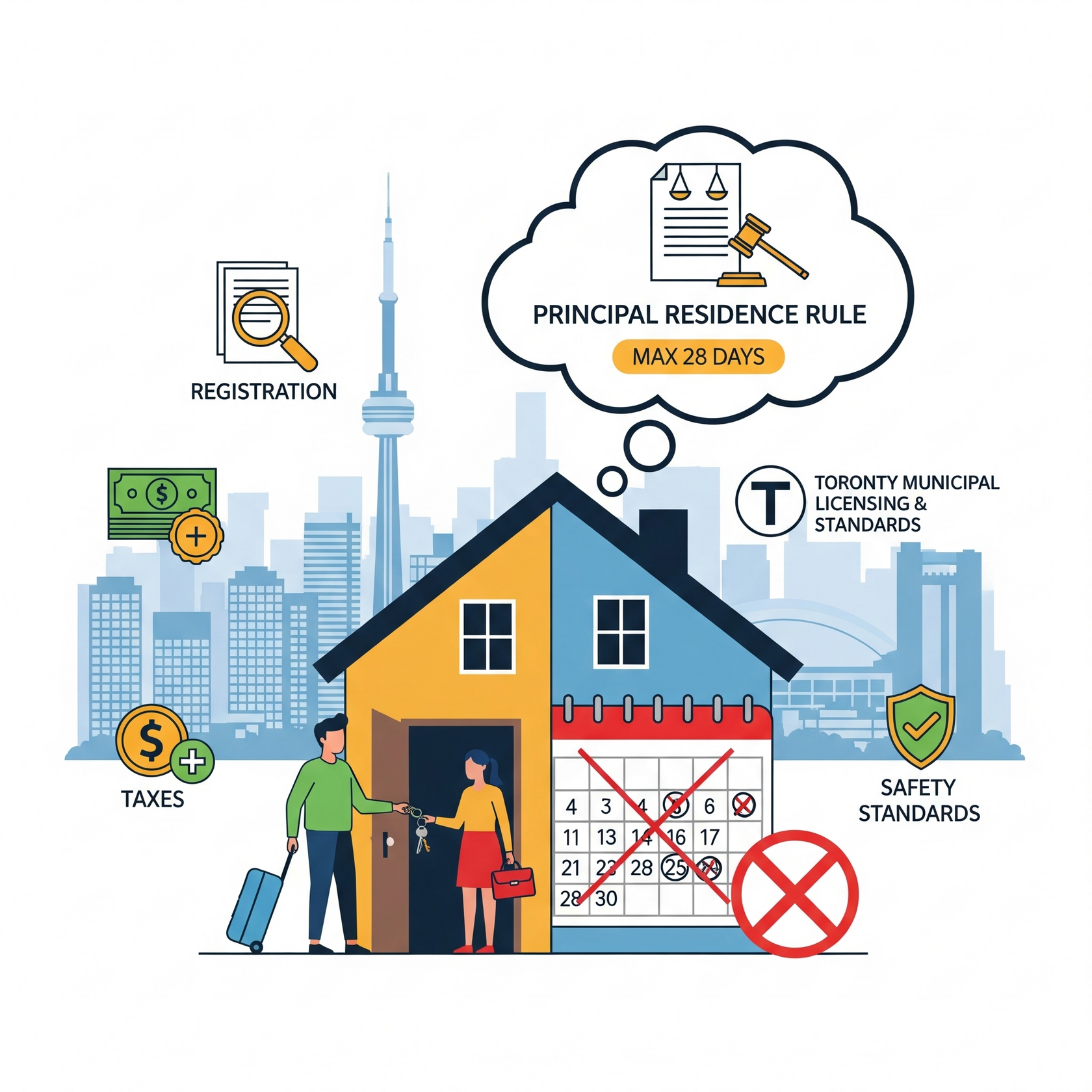
Toronto is one of Canada’s most visited cities, attracting millions of travelers every year. Whether guests are coming for business, to explore the arts and food scene, or simply to enjoy Lake Ontario’s shoreline, there’s always demand for short-term accommodation.
If you’re a Toronto homeowner or tenant, you may be considering short-term rentals as a way to generate extra income. But before you dive into Airbnb, booking.com or other platforms, it’s essential to understand the rules and regulations governing short-term rentals in Toronto. These laws are designed to protect housing availability, maintain community balance, and ensure guest safety.
This blog breaks down Toronto’s short-term rental rules in a human-friendly way—so you know what’s required, what’s allowed, and how to avoid costly mistakes.
What is Considered a Short-Term Rental?
In Toronto, a short-term rental is defined as any accommodation rented for fewer than 28 consecutive days. This includes renting out a spare bedroom, a basement suite, or your entire home while you’re away.
Hotels, motels, student residences, and longer-term leases are not considered short-term rentals. If you’re thinking of hosting, you fall under the city’s short-term rental regulations.
Rule 1: It Must Be Your Principal Residence
The cornerstone of Toronto’s policy is the principal residence rule. You can only operate a short-term rental in the home where you actually live. That means:
Our service is structured to operate in full compliance with regulations designed to safeguard the integrity of the local housing supply. These ordinances prohibit the permanent conversion of residential properties into year-round commercial lodging, ensuring we provide a legally permissible and sustainable service for our customers.
👉 Pro tip for hosts: Make sure you have proper address while leasing out your apartment. If the address didn’t match, it may not qualify.
Rule 2: Entire Home vs. Rooms—You Must Choose
Toronto gives hosts two ways to participate:
1. Entire-Home Rentals
2. Room Rentals
From January 2025 onward, hosts must pick one mode of operation and stick to it. If you select “entire-home,” you can’t also rent out individual rooms, and vice versa.
👉 Ad Astra insight: Condo rentals on Airbnb often outperform both entire-home and room rentals, offering higher returns with less hassle. While some still rent out full homes or individual rooms, condos consistently deliver the best income for hosts year-round.
Rule 3: Registration Is Mandatory
Before you list your property, you need to register with the City of Toronto. This step is not optional. You won’t be able to list your unit on Airbnb or Booking.com for stays under 28 days, as the platform will automatically block your calendar. There’s no way around this restriction.
Registration fee: $375 (new or renewal, every year).
What you need:
What you get: A unique registration number.
This number must be displayed on all listings. Platforms like Airbnb now block unregistered Toronto properties, so registering is key if you want your listing to stay visible.
Rule 4: Municipal Accommodation Tax (MAT)
All short-term rentals in Toronto are subject to the Municipal Accommodation Tax (MAT), similar to a hotel tax.
👉 Pro tip: Always check your platform’s policy on taxes. If you’re managing bookings directly, be prepared to collect and remit MAT yourself to stay compliant.
Rule 5: Safety, Transparency & Guest Trust
Toronto requires hosts to meet safety and communication standards, including:
These measures not only satisfy city regulations but also build guest confidence. A safe and transparent rental is more likely to get 5-star reviews.
Rule 6: Enforcement & Penalties
The City of Toronto actively enforces its rules:
👉 Lesson learned: Don’t treat compliance lightly. Hosts who bend the rules often face penalties that outweigh their rental earnings.
Ready to start your stress-free hosting journey? Contact https://adastra.host/ today for a free consultation and let’s get you on the right track!
If you’re a Toronto homeowner or tenant, you may be considering short-term rentals as a way to generate extra income. But before you dive into Airbnb, booking.com or other platforms, it’s essential to understand the rules and regulations governing short-term rentals in Toronto. These laws are designed to protect housing availability, maintain community balance, and ensure guest safety.
This blog breaks down Toronto’s short-term rental rules in a human-friendly way—so you know what’s required, what’s allowed, and how to avoid costly mistakes.
What is Considered a Short-Term Rental?
In Toronto, a short-term rental is defined as any accommodation rented for fewer than 28 consecutive days. This includes renting out a spare bedroom, a basement suite, or your entire home while you’re away.
Hotels, motels, student residences, and longer-term leases are not considered short-term rentals. If you’re thinking of hosting, you fall under the city’s short-term rental regulations.
Rule 1: It Must Be Your Principal Residence
The cornerstone of Toronto’s policy is the principal residence rule. You can only operate a short-term rental in the home where you actually live. That means:
- It’s the address you use on your government ID, bills, or tax documents.
- It’s the place you normally sleep, eat, and spend most of your time.
- Investment condos, secondary houses, or units you don’t live in full-time cannot be listed.
Our service is structured to operate in full compliance with regulations designed to safeguard the integrity of the local housing supply. These ordinances prohibit the permanent conversion of residential properties into year-round commercial lodging, ensuring we provide a legally permissible and sustainable service for our customers.
👉 Pro tip for hosts: Make sure you have proper address while leasing out your apartment. If the address didn’t match, it may not qualify.
Rule 2: Entire Home vs. Rooms—You Must Choose
Toronto gives hosts two ways to participate:
1. Entire-Home Rentals
- You can rent out your full principal residence.
- There’s a limit of 180 nights per calendar year.
2. Room Rentals
- You can rent up to three rooms in your home minus one room where you live.
- There’s no annual night limit.
- You must continue living in the property while guests stay.
From January 2025 onward, hosts must pick one mode of operation and stick to it. If you select “entire-home,” you can’t also rent out individual rooms, and vice versa.
👉 Ad Astra insight: Condo rentals on Airbnb often outperform both entire-home and room rentals, offering higher returns with less hassle. While some still rent out full homes or individual rooms, condos consistently deliver the best income for hosts year-round.
Rule 3: Registration Is Mandatory
Before you list your property, you need to register with the City of Toronto. This step is not optional. You won’t be able to list your unit on Airbnb or Booking.com for stays under 28 days, as the platform will automatically block your calendar. There’s no way around this restriction.
Registration fee: $375 (new or renewal, every year).
What you need:
- Proof of principal residence (driver’s license, Ontario or photo card)
- Emergency contact details available 24/7.
- Your unit type and hosting mode (entire home or rooms).
What you get: A unique registration number.
This number must be displayed on all listings. Platforms like Airbnb now block unregistered Toronto properties, so registering is key if you want your listing to stay visible.
Rule 4: Municipal Accommodation Tax (MAT)
All short-term rentals in Toronto are subject to the Municipal Accommodation Tax (MAT), similar to a hotel tax.
- Applies to stay under 28 days.
- As of June 1, 2025, the MAT is 8.5% (increased from 6% temporarily until mid-2026).
- Some platforms, like Airbnb, collect this automatically. Others may not—leaving you responsible for remitting it.
👉 Pro tip: Always check your platform’s policy on taxes. If you’re managing bookings directly, be prepared to collect and remit MAT yourself to stay compliant.
Rule 5: Safety, Transparency & Guest Trust
Toronto requires hosts to meet safety and communication standards, including:
- Smoke and carbon monoxide detectors in working order.
- Fire extinguishers and visible exit plans.
- Clearly posted emergency contact information.
- Keeping accurate records of nights rented, rates charged, and guest information.
These measures not only satisfy city regulations but also build guest confidence. A safe and transparent rental is more likely to get 5-star reviews.
Rule 6: Enforcement & Penalties
The City of Toronto actively enforces its rules:
- Platforms share booking data (nights, rates, type of rental) with the city.
- Random inspections can occur to verify compliance.
- Exceeding night limits or operating without registration can result in:
- $700 fines for exceeding limits.
- $1,000+ fines for unregistered or non-principal residence rentals.
- Guaranteed suspension of your license.
👉 Lesson learned: Don’t treat compliance lightly. Hosts who bend the rules often face penalties that outweigh their rental earnings.
Ready to start your stress-free hosting journey? Contact https://adastra.host/ today for a free consultation and let’s get you on the right track!